25.08.2026
Construction insolvency in 2026: the headline number is only the starting point

Construction remains the UK’s most insolvency-prone sector in 2026. That much is not in dispute. But the monthly headline – another rise, another red flag – tells you almost nothing about what actually matters to the people who have to make decisions when a construction business gets into trouble: what can be recovered, which projects are still viable, and what the right course of action is.
What the data actually shows
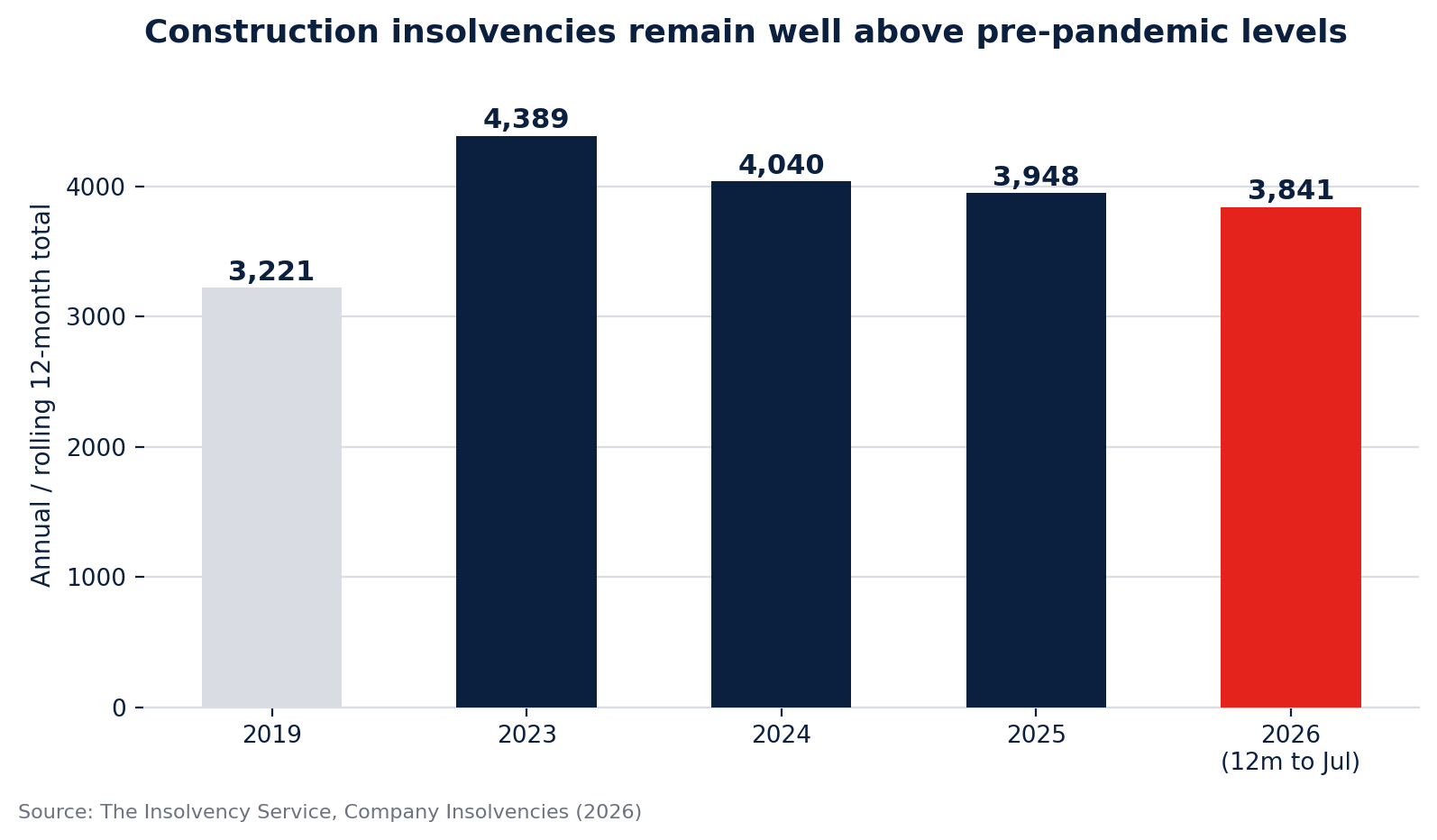
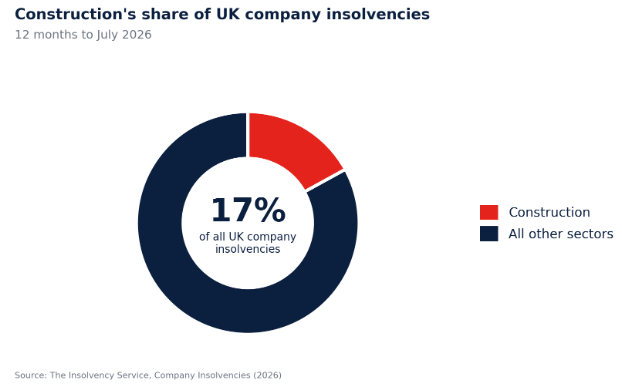
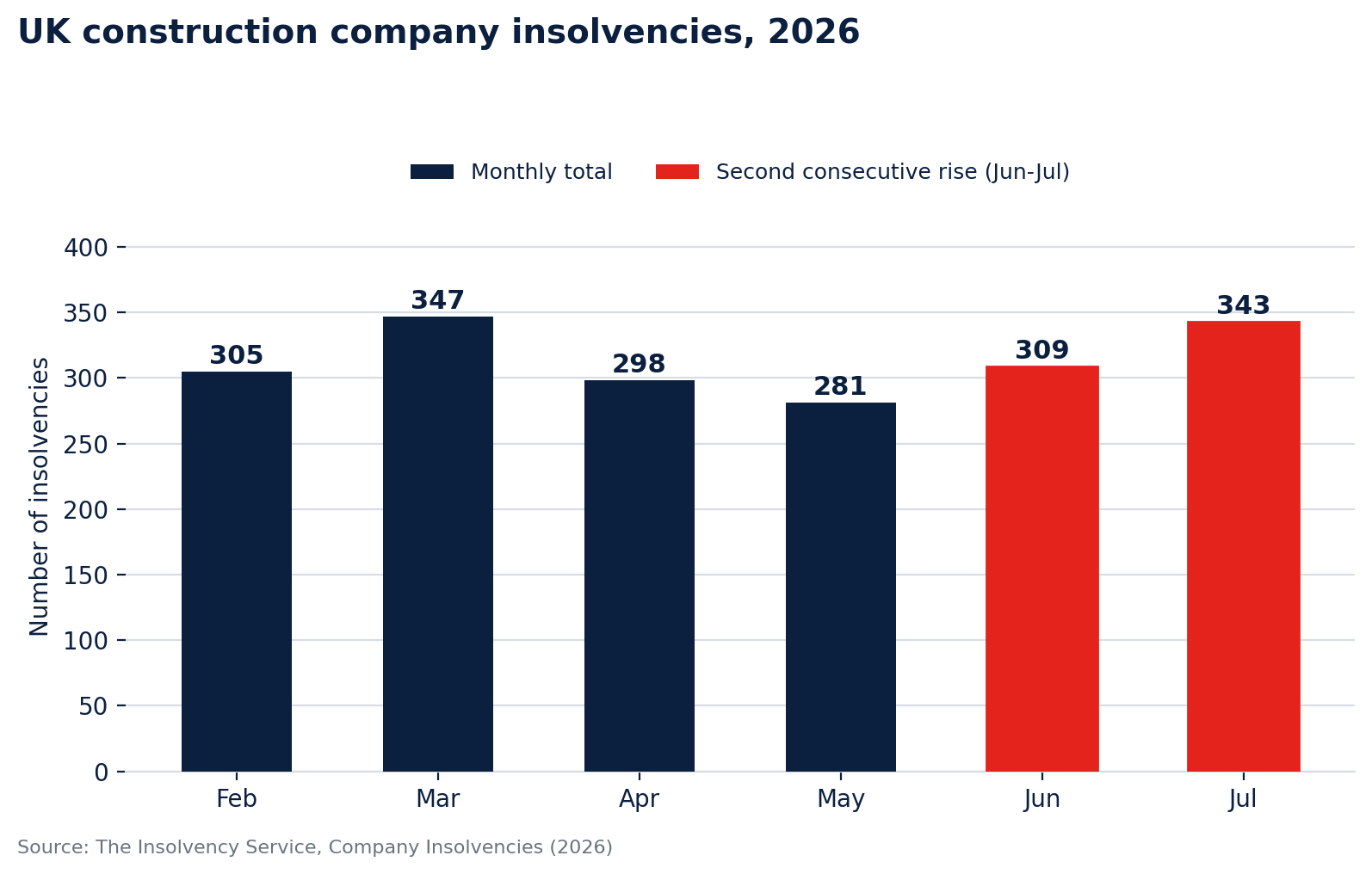
In the 12 months to July 2026, 3,841 construction companies entered insolvency in England and Wales, 17% of all cases where an industry was recorded – more than any other sector. The most recent monthly figures show insolvencies rising for a second month running, up to 343 in July from 309 in June and 281 in May, with specialised construction activities (subcontractors and trades) accounting for over half of that total.
Read across the year rather than month to month, and the picture softens slightly: the rolling annual total is running a few percentage points below the same period last year, continuing a gradual easing from the 2023 peak. But it remains around 50% higher than a decade ago and well above pre-pandemic levels. The direction of travel has improved. The underlying exposure has not gone away.
It’s also worth treating any single month with some caution. Insolvency Service data has repeatedly shown how much clusters of connected companies – particularly in real estate and housebuilding structures – can distort a monthly total. A spike in registrations doesn’t always mean a spike in genuinely separate operational failures, and a single group can produce several company insolvencies behind what is, commercially, one underlying business event. The headline count is a useful signal. It is not the whole picture.
A busy order book is not the same as a healthy business
One of the most important – and most overlooked – dynamics in this year’s figures is that many failing firms are not short of work. Contract awards have surged, job vacancies have hit a two-year high, and construction output has grown over the past few months. Yet insolvencies keep climbing.
That’s because output measures activity, not profitability. A full pipeline can still consume cash rather than create value if contracts were priced before costs rose, payment terms are stretched, variations go unagreed, or the working capital needed to deliver the work outstrips what the business actually has. A contractor can be genuinely busy and getting weaker at the same time – and by the time that shows up as a missed payment or a winding-up petition, the options for an orderly resolution have often already narrowed.
“The headline figures tell you construction generally is under pressure. However it’s clear the impact is being felt most by those who are lower down the supply chain, those who don’t necessarily have the in house capability and expertise needed to manage a business through the current challenges that the industry faces. These are not new challenges. Some of us have seen them before. And all this is despite the fact we are currently seeing plenty of contractors with healthy order pipelines but very often are failing to convert this into cash. For contracting businesses, insolvency practitioners and lenders, the difference between a good outcome and a bad one usually comes down to getting someone in early who’s been there and done it before, to either navigate and avert the immediate crisis and constraints and / or in turn manage efficiently how quickly you can get an accurate, independent picture of an asset’s or order books condition and the real cost to finish it. Speed and early timing intervention are critical.”
Richard Lyndon, Executive Director, Specialist Support Services, Wakemans
Subcontractors are carrying the heaviest load
Look inside the headline figures and the pressure isn’t evenly spread. Specialised construction activities – the subcontract trades: groundworks, electrical, plumbing, plastering, glazing and finishing – consistently account for the largest single share of construction insolvencies, month after month. In July alone, 186 of the 343 construction insolvencies recorded came from this category. Industry economists have been direct about why: risk levels remain particularly elevated for smaller contractors and specialist subcontractors, who bear the brunt of tighter margins and cash flow pressure when demand weakens and payment cycles stretch.
That pressure is structural, not incidental. Subcontractors typically finance labour and materials weeks or months before they’re paid, carry retentions that can sit unreleased for a year or more, and are often among the first to feel the squeeze when a contract above them runs into difficulty – regardless of how well their own business is being run.
The collapse of Ardmore’s construction business earlier this year is a sobering illustration. When six linked Ardmore companies – including Ardmore Construction Group, Major Projects, Regeneration, Fit-out, Hotels & Commercial and Landmark Facades – went into administration in June, following a £14.9m Building Liability Order judgment linked to historic cladding defects, administrators’ filings revealed the scale of the exposure across the supply chain: subcontractors were left owed £23.6m, second only to HMRC’s £34m secondary preferential claim, within total unsecured creditor claims of £61m. Almost 300 former employees were also left owed £3m in wages and holiday pay. With unsecured creditors warned not to expect any dividend, it’s a stark reminder of how exposed the supply chain remains when a contractor above them fails, however established the name above the door.
If you’re a subcontractor or contractor feeling the squeeze
The earlier we’re involved, the more options are available. Our commercial team works directly with subcontractors and contractors navigating cash flow pressure – reviewing outstanding applications, valuations and final accounts, helping turn disputed or slow-moving debt into actual payments, and building a clear, evidenced picture of what’s recoverable and when. That kind of early, practical intervention can be the difference between a business that weathers a difficult trading period and one that runs out of road before it gets the chance to.
We’re able to do this credibly because our team isn’t purely advisory – it includes people with genuine contracting backgrounds, some of whom have managed businesses through previous economic downturns themselves. That means we understand the practical, day-to-day realities of running a business under pressure, not just the numbers on a spreadsheet, but the decisions around resourcing, retentions and cash that keep a business trading, and we bring that understanding to bear when it matters most.
What this means in practice
For funders, developers and main contractors, the risk sits directly in the supply chain – a subcontractor failure partway through a scheme can mean delay, cost overrun and dispute long before it shows up in next month’s figures. For insolvency practitioners, the sheer volume of live cases makes speed and genuine construction expertise essential when assessing whether a business can be rescued, restructured, or needs an orderly wind-down – and IP timelines are often measured in days, not weeks.
The businesses and appointments navigating 2026 most successfully tend to do a few things early: get an accurate, evidenced picture of condition and cost before decisions are made, keep a close eye on delivery once a decision is taken, and bring in independent, technically credible advice well before a winding-up petition becomes the only option left.
How Wakemans can help
Wakemans has provided property and construction consultancy for over 100 years, and our Specialist Support Services team supports insolvency practitioners, administrators, lenders and their advisers with independent, RICS-regulated advice on distressed property assets. Depending on where an appointment sits, that includes:
- Building Condition Surveys & Snagging Reports – a fast, accurate picture of an asset’s physical condition, identifying defects, incomplete works and compliance issues to give IPs a clear evidential basis for next steps
- Cost to Complete Assessments – independent, defensible figures from our Chartered Quantity Surveyors on the funds required to reach practical completion
- Reinstatement Cost Assessments (RCAS) – RICS-compliant valuations ensuring distressed assets are properly insured
- Employer’s Agent / Monitoring Surveyor for Build Finish – hands-on management of cost, quality and progress where a build needs to be finished
- Distressed Project and Margin Recovery – rapid diagnostic review and targeted commercial intervention to stabilise projects and protect stakeholder value
- Forensic Investigation, Insurance and Insolvency Advisory – structured investigations into financial irregularities, governance failings and contractual disputes
We understand that IP timelines are often measured in days, not weeks. Our team mobilises quickly, works across all scales nationwide, and is trusted by developers, funds, lenders and owner-occupiers – and the professionals who advise them.
If you’re an insolvency practitioner, funder, contractor or business owner navigating financial distress in construction, get in touch with Richard Lyndon, Executive Director of our Specialist Support Services team, to find out how we can help.