22.09.2026
The 30-Month Reset: England’s New Planning System and the £27bn Landowner Opportunity
England’s local plan system is being rebuilt from the ground up, and almost every council is now heading toward the same new 30-month process – just as a £39bn government housing programme announces its first allocation of funding. For landowners and land promoters, this is a rare moment when local plan reform and funding are moving in the same direction at the same time.
Where councils stand today
Only around 30% of England’s local planning authorities – roughly 90 out of some 300 – currently have an up-to-date adopted local plan. That figure has barely moved in a year: it stood at just under a third in March 2025 and has crept up to 30% since, even with a burst of 12 new adoptions in the first quarter of 2026 alone.
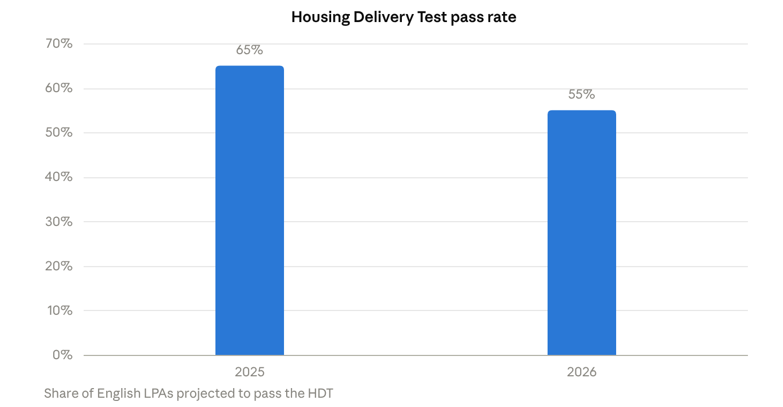
The knock-on effect shows up in the Housing Delivery Test. Modelled results for 2026 project that only 55% of authorities will pass, down from 65% the year before, as tougher 2024 NPPF housing targets bite. A further 30% of authorities are projected to deliver under 75% of their requirement, triggering the presumption in favour of sustainable development on their patch.
One system, three routes in
The Town and Country Planning (Local Planning) (England) Regulations 2026 revoked the old 2012 regulations outright. A plan has to run under one regime from start to finish – there’s no mixing legacy Regulation 18/19 steps with the new process. Every council is now on one of three paths:
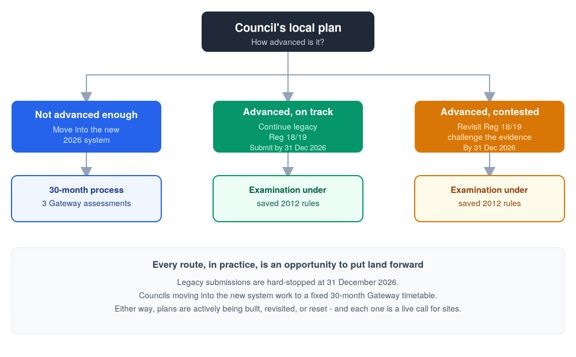
In practice, the legacy lane is narrow and closing fast. Some councils are choosing to abandon advanced legacy drafts rather than push through rules that are about to be retired. For example, West Northamptonshire formally reset its plan to restart under the new 2026 NPPF rather than continue under Regulation 19.
The new system itself is built to move faster and more predictably: with three formal Gateway assessments with Planning Inspectorate involvement (which takes over management of the process from Gateway 2 onward) replacing the old dual-consultation model. A fixed 30-month timetable replaces open-ended plan preparation, and a new strategic engagement framework replaces the former duty to cooperate.
£39bn on the table
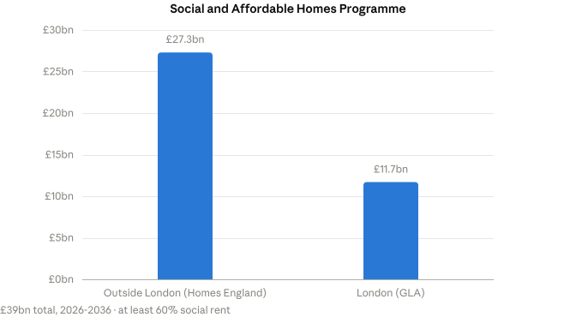
Alongside the planning reset, Homes England has opened bidding for the Social and Affordable Homes Programme (SAHP) 2026-2036: with up to £39bn over ten years to deliver around 300,000 affordable homes, split between Homes England (delivery outside London) and the Mayor’s London Social and Affordable Homes Programme, which has up to £11.7bn available.
The first wave has already landed. In August 2026, Homes England allocated £9.58bn to 33 “Strategic Partners” – housing associations, councils and one private registered provider – to deliver around 73,600 homes over the coming decade. For the first time, councils were named alongside housing associations as Strategic Partners, a deliberate push behind the government’s biggest council housebuilding drive since the early 1980s. That still leaves over £17bn of the outside-London pot, plus most of the London allocation, still to be committed over the rest of the programme – so the bidding window is far from closed.
At least 60% of homes funded must be delivered at Social Rent, and the programme sits behind the government’s wider commitment to 1.5 million homes this Parliament. Registered providers, local authorities, housebuilders, developers and community-led organisations can all bid, individually or as part of a consortium.
What this means for landowners
Put the two pictures together, and the opportunity comes into focus. Seven in ten local planning authorities still don’t have an up-to-date plan, and most of them are now committed to building one under a fixed 30-month timetable rather than an open-ended legacy process. Each of those plans is a live call for sites – a moment when land can be put forward for allocation. At the same time, up to £39bn of grant funding is actively looking for deliverable affordable housing schemes to support.
The catch is that the clock is ticking. Legacy submissions are hard-stopped at 31 December 2026. Authorities moving into the new system are working to a fixed Gateway timetable with far less room to patch a weak submission later than the old process allowed. Sites that aren’t cost-ready when a plan-making window opens risk missing it – and, once a plan is adopted, the next window may not come for years.
How Wakemans can help
Getting a site allocation-ready – and keeping it competitive once it’s in a Gateway process with little room for iteration – depends on evidence that stands up to scrutiny from day one. Wakemans works alongside landowners, land promoters, developers and housebuilders, surveyors and consultants, producing Viability assessments on exactly that evidence base:
Service |
What it does for your site |
| Residential build costs | Realistic, evidenced cost plans that hold up at Gateway assessment or review of the BCIS data set used in conjunction with Valuer and % inputs used for Externals, Professional Fees, Contingencies etc. |
| Abnormal and site-specific costs | Identifies the costs that can undermine a viability case if missed early or might be overestimated due to lack of site surveys which would make the site appear unviable. We can advise what additional surveys and investigations should be carried out to mitigate and manage any potential cost risks. |
| Onsite and Offsite Infrastructure and external works, Drainage, Incoming services and Utilities costs | Costs of the enabling works required to make a site deliverable and advise on the likely cost of access and Spine roads required. Availability/cost of services infrastructure or any restrictions such as diversions or upgrades required. |
| Affordable housing cost and delivery | Feeding into Financial Viability Appraisal carried out by Valuer to assess S106 and affordable housing requirements on the site. Can act as Expert if Planning Inspectorate is involved as part of the appeal process. |
| Cost benchmarking and sensitivity analysis | Stress-tests viability using available real-life data on a confidential basis. |
With the new system now the default route for most local authorities, the question isn’t which regime your site will go through, – it’s whether it will be cost-ready when the opportunity arrives. That’s where Wakemans comes in. To find out more, speak to our Residential team here